Translate

Showing posts sorted by relevance for query billionaires. Sort by date Show all posts

Friday, March 20, 2026

One Trillion Dollars

Evil Jeff Bezos is in the news planning to do some more evil shit so I thought I'd republish this from late last year. Like many of us, I'm just yelling the same things over and over because they are always true and it always makes me furious.
Once again, the answer to all our questions is: Money (and once again, h/t Tony Kornheiser)


Just a quick word about Elon Musk and the tussle over whether to pay him a trillion dollars as Tesla's CEO. In the November 6 issue, the New York Times asks the important question: "Would Elon Musk Work Harder for $1 Trillion Than $1 Billion?" (no link, because fuck the New York Times) I didn't read it because I don't give a shit what their answer is because, again, fuck the New York Times.

The question reminded me of something I've thought about for ever. Why do we think that billionaires making less money makes billionaires want less money? Do we do that with poor people? Working people? Do we believe that paying people less per hour makes them want and need more hours or fewer hours? Do we believe that taxing the money above a billion makes billionaires quit at a billion? Or go find a different job?

I'm convinced that the biggest lie in capitalism--among thousands--is that if Big Brain Masters of the Universe don't get their money (including their tax breaks and their public investments and etc.), they'll close up shop and tell everyone else to suck it. 

I think that's extortion, and I don't think it's true.

When it comes to how we think about money, I think there are two kinds of people. One kind of person thinks about the life they want to have and thinks of money as the way to get that kind of life.

The other kind of person thinks of money as a way to keep score in the big game of World's Greatest Human (aka Biggest Asshole).

For the first kind of person, money as a means to a material end might mean feeding your family, a decent car, a home of your own. For lots of people it's being able to pay your medical bills. Send your kids to collegeTravel once in a while. You know, normal shit. For this kind of person, if you have enough money you can get the life of your dreams, so you work and save to have that life.

For the other kind of person, there's no such thing as enough money. It's not a means to an end, it's a competition. That means if you make a million and someone else makes two, you're losing. If you make a billion or ten, that doesn't put you ahead in the race against eight billion other people; it puts you behind a couple thousand other assholes. 

In other words, this kind of person can never get enough money because somebody's always got more or they're trying to get more. They're not working for enough; They're working for more, more than anybody else. 

Which is why, if Elon Musk lost 459 of the 460 billion dollars he now owns, he would never ever not in one billion years stop trying to make that 459 billion dollars back again -- and then a trillion more. That goes for the rest of the goddamn billionaires, too.

In the 1980s, people said, "Whoever dies with the most toys wins." That was greedy and selfish, but at least it was tangible. Toys could be played with. Today's billionaires have an empty hole right through the middle of them, and they can never earn enough or steal enough or inherit enough to ever fill it. (h/t Kevin Jarre, 
Tombstone)

We have too many goddamn billionaires, and billionaires ought to be illegal. 

It's hilarious to hear a bunch of middle-aged, middle class folks cry for the billionaires and vote to protect them from the communist socialist leftist antifas. 

I imagine it's especially hilarious to billionaires who shout "look over there!" as they scoop all the money into numbered bank accounts or crypto accounts or whatever else I wouldn't know about because I'm not a goddamn billionaire. 

I don't know a single billionaire, nor do 99.99% of the people screaming to keep our commie hands off the money owned by billionaires. "Be nice! Don't make them mad! They'll quit and take all the jobs with them! They'll stop making new iPhones and bad newspapers and weird trucks and delivering our toothpaste in three hours!" 

What is it we're really afraid of? What would we lose if we lost all the billionaires? 

What would we lose if one morning they all became just millionaires

It's stupid that the rest of us do all that screaming for them.

Now there's goddamn trillionaires.


If you want to know why things have gotten so fucked up, follow the money.

Further reading: Why is everything so fucked up?


Thursday, June 5, 2025

Why is everything so fucked up? revisited

Don't-give-a-fuck Republicans are preparing to cut Medicare, Medicaid, nutrition assistance, education, research, national parks, clean energy, and agencies such as the EPA and BLM and NASA, and programs like USAID (and what else? even Congress hasn't read the damn bill), all in exchange for mass deportations, a bigger defense budget, and humongous tax cuts largely for billionaires (which is cool because the bill also cuts IRS enforcement focused on billionaires!), I thought it would be a good time to re-up this simple Q & A for how everything got so fucked up. Here goes.


                     The answer to all your questions is: Money.

According to teevee host and former sportswriter Tony Kornheiser, television producer and network big shot Don Ohlmeyer once told him, "The answer to all your questions is: Money."

When we try and figure out how we got into this mess, I'm sure many of us can point to our own favorite incident, policy, condition, cause, or villain, as the reason things are so fucked up. When it comes up among friends, individual lists grow and merge into a gigantic trail of crimes and outrages and, of course, they and we are all correct. I don't even have to open my mouth anymore. When it's my turn everyone just shouts "Reagan!" before I can open my mouth. 

Turns out I may have a case, of sorts. 

A working paper from RAND released in February examines income inequality among U.S. workers. It builds upon an earlier study, and RAND describes it this way: "This short analysis extends the results from a prior study about the gap between what the majority of workers earned from 1975 to 2018 and what they would have earned with more evenly distributed income growth (Price and Edwards, 2020)." It's a short, clear, easy read and I encourage you to take a look at it here, but the money shot is as follows (emphasis mine):

These values are intended to provide an indication of the scale of rising inequality and its durability over the last nearly five decades. Looking at the net effects of these trends, if we had the income distribution from 1975, the majority of workers (the bottom 90 percent by income) would have made an additional $3.9 trillion dollars in 2023. Cumulatively, the gap between what workers from 1975 to 2023 earned and what they would have earned with the counterfactual income distribution amounts to $79 trillion (in 2023 dollars). Compared to the $47 trillion from the 2020 study, the additional $32 trillion dollars comes from extending the time-period by five years, inflating from 2018 to 2023, and additional growth in inequality.

Seventy-nine trillion dollars is a lot of money. A lot of child care and college educations and homes that could have been passed down to help create generational wealth. Instead, "the bottom 90 percent" did not fully participate in the growth of the American economy they helped produce. You know who did? You know who reaped their own benefits and a giant share of everybody else's? Sure you do. 

And not for nothing, there's this from the RAND paper:

For three decades following the Second World War, incomes for workers across the income distribution grew at the same pace as the broader economy. This changed in the late 1970s, when earnings growth began disproportionately flowing to those with the highest incomes leading to four decades of rising inequality.

Here it is graphically, from the Economic Policy Institute:


The late 1970's. Arthur Laffer. Jack Kemp. William Roth. Voodoo supply-side trickle down "economics." And do you know who endorsed this nonsense, who ran on it and was elected in 1980? Sure you do. 

That is a huge part of how we went from thirteen U.S. billionaires in 1980 to over 900 today (+ around 7000 percent). Since geographical distinctions are not what they used to be, it's also instructive to note that Forbes reports its own count as rising from 140 billionaires worldwide in 1987 to 3,028 today. Up 2162% give or take. It's been a good run if you're a billionaire and/or heir to one. For the rest of us, not so great. 

And that is a big reason why everything is so fucked up.

Thanks for reading. Speak to you soon. 


Friday, June 12, 2026

Too many goddamn billionaires

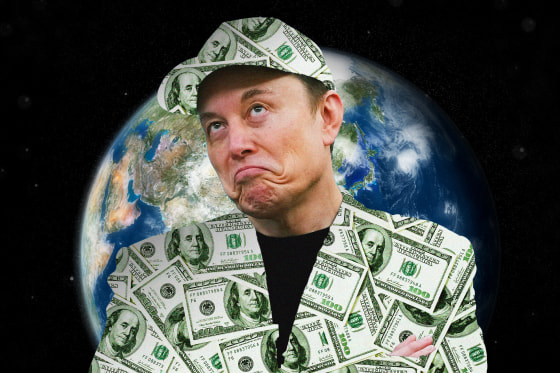
 Photo illustration of Elon Musk dressed in a suit jacket and hat made of $100 bills against the Earth, as seen from space.  There it is.

All I remember seeing is rockets crashing and exploding, but whatever. 

My point is that this is immoral and poisonous, and it ought to be against the law. 

In other words: Why is everything so fucked up? Too many goddamn billionaires. 

And now there's fucking trillionaires.


Saturday, April 5, 2025

Why is everything so fucked up?

                      The answer to all your questions is: Money.

According to teevee host and former sportswriter Tony Kornheiser, television producer and network big shot Don Ohlmeyer once told him, "The answer to all your questions is: Money."

When we try and figure out how we got into this mess, I'm sure many of us can point to our own favorite incident, policy, condition, cause, or villain, as the reason things are so fucked up. When it comes up among friends, individual lists grow and merge into a gigantic trail of crimes and outrages and, of course, they and we are all correct. I don't even have to open my mouth anymore. When it's my turn everyone just shouts "Reagan!" before I can open my mouth. 

Turns out I may have a case, of sorts. 

A working paper from RAND released in February examines income inequality among U.S. workers. It builds upon an earlier study, and RAND describes it this way: "This short analysis extends the results from a prior study about the gap between what the majority of workers earned from 1975 to 2018 and what they would have earned with more evenly distributed income growth (Price and Edwards, 2020)." It's a short, clear, easy read and I encourage you to take a look at it here, but the money shot is as follows (emphasis mine):

These values are intended to provide an indication of the scale of rising inequality and its durability over the last nearly five decades. Looking at the net effects of these trends, if we had the income distribution from 1975, the majority of workers (the bottom 90 percent by income) would have made an additional $3.9 trillion dollars in 2023. Cumulatively, the gap between what workers from 1975 to 2023 earned and what they would have earned with the counterfactual income distribution amounts to $79 trillion (in 2023 dollars). Compared to the $47 trillion from the 2020 study, the additional $32 trillion dollars comes from extending the time-period by five years, inflating from 2018 to 2023, and additional growth in inequality.

Seventy-nine trillion dollars is a lot of money. A lot of child care and college educations and homes that could have been passed down to help create generational wealth. Instead, "the bottom 90 percent" did not fully participate in the growth of the American economy they helped produce. You know who did? You know who reaped their own benefits and a giant share of everybody else's? Sure you do. 

And not for nothing, there's this from the RAND paper:

For three decades following the Second World War, incomes for workers across the income distribution grew at the same pace as the broader economy. This changed in the late 1970s, when earnings growth began disproportionately flowing to those with the highest incomes leading to four decades of rising inequality.

Here it is graphically, from the Economic Policy Institute:


The late 1970's. Arthur Laffer. Jack Kemp. William Roth. Voodoo supply-side trickle down "economics." And do you know who endorsed this nonsense, who ran on it and was elected in 1980? Sure you do. 

That is a huge part of how we went from thirteen U.S. billionaires in 1980 to over 900 today (+ around 7000 percent). Since geographical distinctions are not what they used to be, it's also instructive to note that Forbes reports its own count as rising from 140 billionaires worldwide in 1987 to 3,028 today. Up 2162% give or take. It's been a good run if you're a billionaire and/or heir to one. For the rest of us, not so great. 

And that is a big reason why everything is so fucked up.

Thanks for reading. Speak to you soon. 


Wednesday, February 2, 2022

The answer to all your questions.

Via Tony Kornheiser, writing for the Washington Post in 1994: 

"TV wizard Don Ohlmeyer ... once told me, 'The answer to all your questions is: Money.'"


The superb Robyn Pennacchia @RobynElyse over at Wonkette has an excellent article that connects the dots between the hostility being directed at educators and the larger project of undermining public schools in order to privatize and cash in on education. 

It should surprise exactly no one that many of the loudest voices protesting and threatening teachers, administrators, school board members and even students themselves are Republican operatives, political hacks whose brief extends far beyond the banning of "uncomfortable" books and history or the rejection of school safety measures.

These ideological shock troops masquerade as concerned parents while acting as political goons, aided and abetted by Fox and the massive conservative ecosystem which promotes them while deliberately shielding their true identities, and enabled by a timid mainstream media that refuses to honestly describe and expose them.

Pennacchia describes the process:

Within the last couple years, there has been what seems like a massive uptick in outraged parents. Parents who are mad about masks, parents who are mad about books, parents who are mad about "critical race theory." They show up at school board meetings across the country to yell their faces off, frequently going viral due to the sheer number of stupid things they manage to fit into the three minute allotment they have to talk.
We're supposed to believe that these are grassroots efforts led by concerned parents who just want a say in their children's education. That these groups they form are organic. That those participating in them are, in fact, actual parents in the school district they're protesting in.
Of course, those of us who are hep know a large number of these people are not so much parents as they are Republican strategists, activists and think tank employees. That doesn't mean that there aren't parents who are "concerned" about these things — but it does mean that their outrage about them is being purposely stoked by professionals with an agenda.

And the agenda? What is the ultimate goal of inciting all this animosity and pointing it "march to the capital" style at educators? Pennacchia continues:

The obvious, immediate agenda is to get Republicans elected. Glenn Youngkin's victory in Virginia, for example, was largely spurred by parental outrage over masks and critical race theory.

But that may not be all they are after. As Truthout reports, many of the organizations ginning up the hysteria over these issues are simultaneously involved in efforts to encourage the privatization of schools by undermining support for public schools.

For years, the goal of school privatization advocates has been to oppose funding for education and then criticize the public school system for failing, hoping that this will lead to parents taking their kids out of schools and becoming increasingly supportive of voucher programs and so-called "school choice," with the ultimate goal being a for-profit education system usurping the public education system.

Penacchio goes on to quote this very good Truthout piece peeling back the veneer covering the scam. From Truthout:

School privatizers seem to know that sowing enough distrust in public education — and capitalizing on the genuine frustration of parents struggling to cope with pandemic-related work, schooling and child care issues — could fulfill their “great disenrollment” prophecy. One strategy of these “parent” groups seems to be using easily replicable resources to attack public schools, deploying them in school districts nationwide and attracting right-wing media coverage. 

Liat Olenick @Liat_RO raised the issue in a great article in The Nation, connecting the attacks over COVID and "Critical Race Theory" and describing them as "a primary Republican organizing strategy." The project to enfeeble public schools is well-funded and comprehensive:

What unites all these attacks are the right-wing, anti-union billionaires who benefit from them: The anti-CRT furor is a coordinated attack on the institution of public education and multiracial democracy, designed to justify defunding public schools and replacing them with segregated charter schools and voucher programs. The current attacks on teachers over Covid safety demands serve the very same purpose. The hedge fund managers and billionaires who have funded the charter school and school voucher movements for the past two decades are the same elites who stand to benefit from this latest raft of anti-teacher, anti-union vitriol.

Of course, educators in public schools are also familiar with contempt from the nominal "left."  We are witnesses to the charter school craze and white flight, and we sure as hell remember "Race to the Top" and Arne Duncan (looking at you Barack Obama). The pandemic, with its nondenominational rancor over masking and in-person schooling, has cranked the volume up to 11. 

Olenick rightly observes that even--I'd say especially--during these miserable times, "the vitriol isn’t just coming from Republicans, but also from leading “liberals” who conveniently refuse to hold politicians accountable for failing to implement basic mitigation strategies to keep schools open but are extra-eager to attack teachers’ unions demanding things like soap in the bathrooms and minimal Covid testing." And she has a warning for us:

The failure to confront authoritarianism and the failure to defend public schools and educators from Covid is the same failure. When an institution is a cornerstone of democracy, you fight for it, you fund it, and you respect it.
Democrats ignore attacks on teachers and schools to their peril. There is no democracy without public education. There is no public education without qualified, caring, and dedicated teachers.

In Olenick's words: "Healthy democracies don’t hate their teachers."

The other side--Republicans, religious conservatives, true believers and opportunists--are well-organized and committed. Theirs is a comprehensive, methodical plan for the destruction of a public institution and the transfer of its assets to private, commercial entities. You can see the plan playing out in real time in Virginia (h/t @jbouie). Like ALEC writing model legislation to be cribbed by legislatures all over the country, Youngkin and his Virginia mobsters have created the template for reducing public schools to rubble. 

When combined with pre-existing conditions such as diabolical funding formulas and the national testing addiction, this present demonstration of outrage over everything from masks to the accurate teaching of history spurs parents and students to take advantage of "school choice" portals, leave their former (public) schools impoverished, and delivers an entire system ready to be stripped down and sold for parts.

It's a pretty dreary picture and can feel like the ship has already sailed. As a teacher, I was always inside the event horizon. I could feel the gravity of freemarket schooling as it was warping spacetime and sucking the life out of my little corner of the universe, but what was I supposed to do about it? It was overwhelming and seemed unstoppable. I had 180 students. I was fucking busy.

What I didn't know and didn't have time to learn was that I wasn't alone. Other people felt like I did--and I'm not just talking about the half dozen in my "this sucks" lunch group. Now I know that lots of people--big important people--have been fighting this battle for decades, some of them successfully. The Profiteers and Privatizers are playing the long game but they haven't yet won the war. There's still time to join the fight. 

I'm just getting started and the sheer weight of what I don't know could tip the earth off its axis. However, I am exploring lots of different resources and include some of them here. I have not had time to fully vet them all, and if you have additional suggestions, please share. 

Diane Ravitch, author, historian and former Assistant Secretary of Education, has been a leader in this battle. Her blog is must reading and I'm working my way through her books, especially The Death and Life of the Great American School System: How Testing and Choice Are Undermining Education; Slaying Goliath: The Passionate Resistance to Privatization and the Fight to Save America's Public Schools; and now Cutting School: The Segrenomics of American Education co-authored with Noliwe Rooks. It takes time, but I'm retired and now I have time. I want to go to war fully armed. 

Ravitch also is president of the Network for Public Education, and though some of its material could be updated (toolkit), the website provides a very good rundown of organizations around the country that are fighting to save the public in public education. Email is here for more information.

There are other resources I've discovered as I've been teaching myself what lots of others seem to already know. On her blog, Diane Ravitch writes that an organization called
UnKoch My Campus "does a great job of tracking and exposing the influence of billionaire Charles Koch in schools and higher education." According to their website they are a
 "fiscally sponsored project" of Essential Informationthe Ralph Nader-founded (1982) non-profit. Their K-12 report for 2020-2021 identifies many of the major players and details the strategies of the Koch Network's "capture" of education Privatization Plan and illustrates it this way:


It's a good graphic, though test scores and the national testing addiction really deserve their own space around steps 3 and 4.

Jennifer Berkshire @BisforBerkshire is a writer I'm now becoming familiar with. Her "Have You Heard" podcast is excellent and I'm looking forward to reading A Wolf at the Schoolhouse Door, co-authored with Jack Schneider. I first heard her speak about her work on the Know Your Enemy podcast.

"C'mon Waid," some of you might be thinking. "I did not come here for extra homework. I have 180 students right now, and you want to give me a reading list?" That's not it. I'm just telling you what I'm reading. So I understand the terrain and I'm not just bullshitting about what things used to be like. So I can get a clearer, more complete picture of our enemies, and our friends. And, ideally, to help you understand that you are not alone.

It would be helpful to have some models of successful resistance. Within the network of teachers, allies, and all advocates for public education and its offspring, multiracial democracy, we should be able to identify effective strategies and replicate them in diverse locations under varying circumstances. We're smart enough to reproduce successful plans just like the bad guys, only we use our power for good. 

I did manage to find a few ideas. Here, for example, Diane Ravitch joins a panel of international educators in a discussion titled "Fighting the Privatisation of Education," presented by the University of New South Wales Centre for Ideas, among others. I find Ravitch generally too optimistic regarding the impact of the pandemic on the public's attitudes towards schools and the people who work there. However, these remarks all predate the current "CRT"/book banning/masking brouhaha, so perhaps that explains it.  

It's a good conversation and much of it may sound familiar. Nevertheless, as we continue to learn the battlefield and our enemies and allies, we are still in the middle of an active warzone. What can a teacher do? What are some specific actions we can take to impede the drive to privatize public schools? When I know more, I'll say more, but for the time being I'll rely on Ravitch. I know you're busy I'll save you some time. 

Shorter Diane Ravitch: 
  • Join your union. (Waid editorial: Just shut up and do it. They're not perfect, but if you think a union is expensive, try not having one.)
  • Collaborate and organize with like-minded individuals around the country (Network for Public Educationand the world in order to amplify your voice. 
  • The road to privatization is paved with testing data, so align yourself with the opt-out movement in your state 
  • Read Slaying Goliath.

Later this month I'll be starting Goliath, which is advertised as a collection of successful stories and strategies from around the country. I'll share them in a future post. In the meantime, please, if you have ideas that have worked for you or a colleague, please do share them in the comments section. You may comment anonymously if you prefer.

During my career I pushed back against bad administrators and bad policies at my schools and helped lead a strike against my district--all on behalf of my students and their families. I worked to support public schooling and fought threats like excessive testing and school choice, but my efforts were limited and local. Looking back, I spent my career in a silo grinding my teeth and shockingly unaware that there was an entire community of resistance just outside my classroom walls. Now I'm outside those walls and I have the time and bandwidth to educate myself and become part of that community. 

Fundamentally, this fight is about much more than a particular ideology, or politicians seeking to evade responsibility, or parents' rights (which, let's face it, is really just hostage-taking by the most extreme parents available), or fear, or class, or religion. It goes beyond someone's idea of morality, or even racism. All these are crucial elements of the battle, but they are engineered primarily to achieve the objective. The same plan was, is, or will be used to turn other public institutions into private profit centers. From the U.S. Postal service to national parks to public schools, it's up to us to protect them. 

The struggle is grueling because the stakes are high. Money is power and power concedes nothing. So if you ever wondered why school board meetings are now screaming matches or how "CRT" is even a thing, or when you see book banning and ask "What the actual fuck is going on?" remember: 

The answer to all your questions is money. 


Thursday, February 23, 2023

Playing Politics: How did teachers get to be the bad guys?

 We have met the enemy, and it is us ???

If you are wondering how teachers got to be the bad guys, you are definitely in the right place. Of course, it's complicated.

Take a profit-driven industry pissed off about labor costs,

Mix in a bunch of taxpayers pissed off about paying taxes,

Sift together free-market monomania, political ambition and religious fanaticism,

Marinate in racism, sexism, and a scoop of toxic nostalgia (at least overnight, over centuries is best),

Stir in memories of all the terrible teachers you ever hated and

Voilà!


We have definitely been depicted as villains; let's take a look at how and why.

Teachers are viewed by the privileged and powerful as the delivery systems for dangerous ideas such as LGBTQ+ rights and race equity (don't say anti-racism!) and, of course, income equality. Therefore, educators are at the nexus of legislation prescribing what can and can not be taught (and how), and the implementation of those laws. In other words, teachers are responsible for sanctioning and distributing certain kinds of knowledge while delegitimizing and withholding others.

We'll start with the laws. I'll focus on "CRT," sex, and "parents' rights" for now and leave most of the mask mishegoss for next post when we'll get to the who and why of all the bashing. (For those of you looking for a school choice rage party, please be patient.)


It's not just for Florida anymore. It never was.

UCLA School of Law has a CRT Forward Tracking Project. It has an interactive map and, as they describe it, "includes state and federal legislation but also goes much further, into areas where systematic research tools are sparse. It tracks actions by school boards and other local governments, as well as non-legislative actions at the state level, such as regulations, executive directives and attorney general opinions." 

The ACLU has an interactive chart "Mapping Attacks on LGBTQ Rights in U.S. State Legislature[s]" that links to the text of bills and provides each bill's status.

Parents' Rights are all the rage, and they serve as the rich canopy under which anti-CRT, "don't say gay," and rules for book-banning and outing kids to their parents, can grow and flourish. These PR bills may take first place in the "words mean what I want them to mean" race. 

Most of what's in most of the bills is a rehash--this time louder and in ALL CAPS--of stuff parents already have and can do. Section 445 of the General Education Provisions Act (first passed in the 1970s and re-upped in 2020) gives parents the right to view instructional materials and opt their students out of surveys and "analysis" based on challenged materials. When it comes to sex, most states already require parent notification and offer an opt-out (or opt-in) to families. That doesn't stop these folks from passing the same "new" law over and over. Red meat eaters need red meat.

This is the latest from PEN America. Read it and weep.

They get away with birthing this calamity in part because the laws hurt the people the base wants hurt, and partly through rhetorical legerdemain. The language of the bills is both redundant and deliberately ambiguous. Concepts like "age-appropriate" and "unsuitable" rely on nonexistent good faith and invite parent/?/activists and the billionaires who own them to contest lessons and materials that conflict with their personal (corporations are too persons!) ideologies. 

As a result, the laws that claim to promote transparency and protect a parent's right to "direct" their child's education function as a way for those parents to also direct the educations of other parents' kids. Rights for me, not so much for thee.

The bonus is the ability for parents to sue for damages and costs along with "injunctive relief" if the school district does not rectify the issue to the parent's satisfaction. This is the main mechanism for chilling speech and erasing disfavored knowledge, experience, history, and people from the public conversation that occurs in schools. 

If you're thinking that most people won't go so far as to sue a school, or that they can't afford to, you might be right. But there are a lot of interested groups that are eager to finance just such an effort, and as anyone who has worked in a school can tell you, the bosses are terrified of lawsuits. So terrified you don't actually have to bring them. Maybe one or two.

Reminds me of The Maltese Falcon

Gutman: "Well, sir, there are other means of persuasion besides killing and threatening to kill."

"Sure," Spade agreed, "but they're not much good unless the threat of death is behind them to hold the victim down."

For now, the lawsuits can go both ways. But not smoothly

Of course not all of these legislative grenades make the national news and when they do, as in the New York Times here and the Washington Post here, NBC here and ABC here,  the reports have often just reviewed some of the hundreds of bills proposed. And in Congress, a federal "Parents' Bill of Rights Act" remains under the radar and has so far made barely a ripple.

Even when it does occur, reporting on the bills is usually smothered in partisan horse-race "analysis" that rarely pierces the veneer of process and "for the children" bad faith. Instead, these articles split their inches between dramatic horror stories from the frontlines and tedious "who's winning?" back-and-forth conflict porn. 

What is much harder to find is an honest investigation into the origin and purpose of these culture wars. Kathryn Joyce who writes for Salon and Vanity Fair among others, has this, about which we will hear more next time (Vanity Fair also has this and this.) The New Yorker has this and that.

In the blog and blog-adjacent universe, Peter Greene @palan57 does a great job connecting the dots at Curmudgucation, Forbes, and The Progressive

Anne Lutz Fernandez @lutzfernandez puts it together on her substack

Steven Singer @StevenSinger3 is a Gadfly on the Wall who has been at it for a while

Nancy Flanagan @nancyflanagan is a Teacher in a Strange Land

Jan Resseger @JanResseger brings the hammer on her blog, sometimes reprinted on the awesome... 

...Network for Public Education @Network4pubEd website (boasting a team that includes Executive Director Carol Corbett Burris @carolburris and Leonie Haimson @leoniehaimson, Executive Director of Class Size Matters), and on... 

...Diane Ravitch's essential blog that serves as a crucial platform for amplifying these voices along with many others. 

For the digitally inclined, Jennifer Berkshire and Jack Schneider are masters of the domain with their podcast, Have you Heard.

For the enlightened and antediluvian, there are books! I haven't read them all, but I'm still young (at heart) and still learning. The following titles are a sample of those I've either bought, started, finished, or had recommended to me.

A Wolf at the Schoolhouse Door: The Dismantling of Public Education and the Future of School by Schneider and Berkshire

Schoolhouse Burning: Public Education and the Assault on American Democracy by Derek Black

And anything from Diane Ravitch, but especially The Death and Life of the Great American School System: How Testing and Choice Are Undermining Education

There is a lot more than culture wars legislation in the work of these writers. If you want to know what's really going on out there, you should start here. Read their stuff. Listen to it. Follow them on twitter. Don't spend your career in a silo like I did. 


Next up, the guest of honor. The hero responsible for bringing together all the bad ideas and shitting them out as a state-sized turd hanging off the asshole of the country. Florida Man.